My Approach
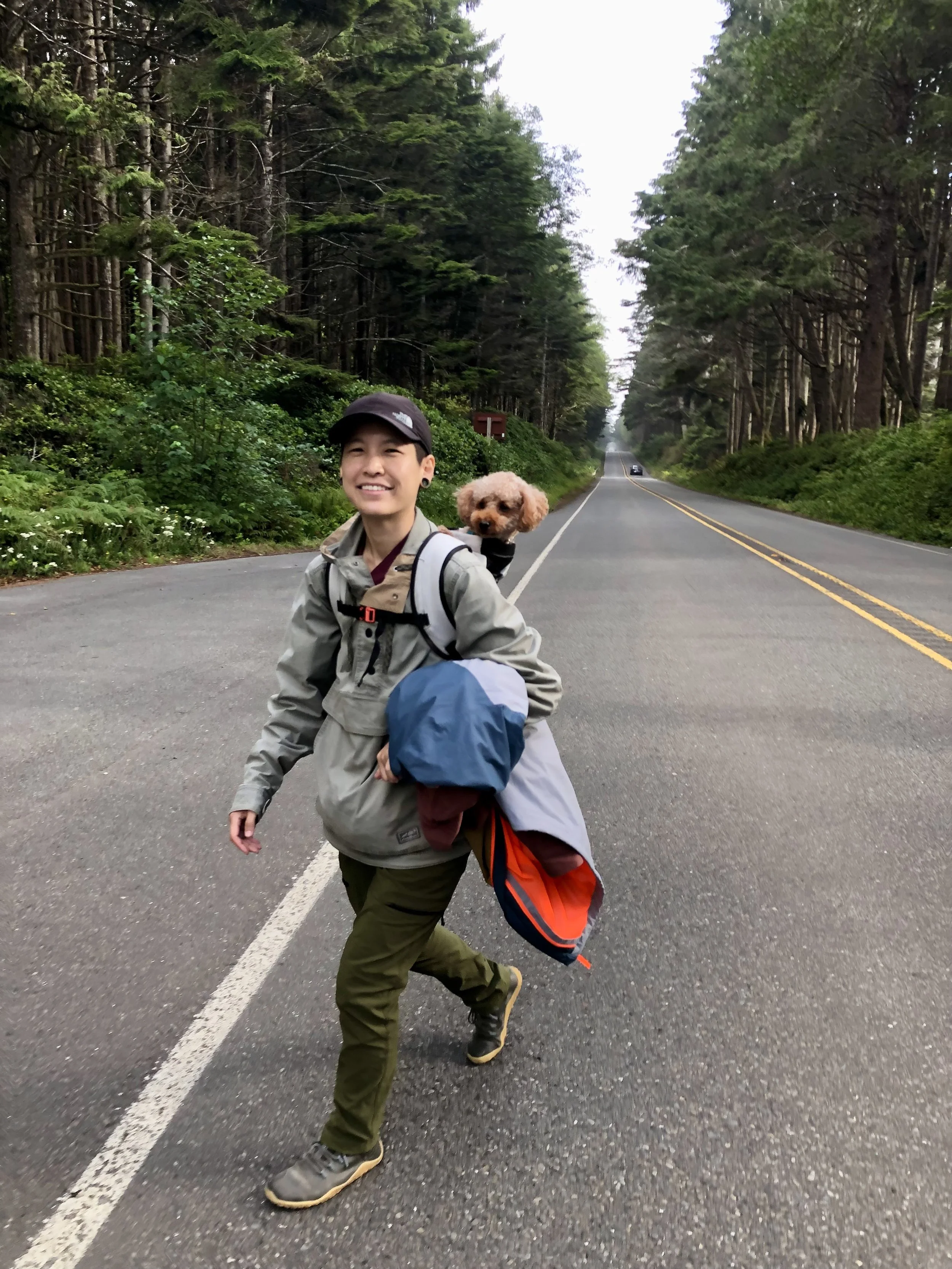
Hi there! My name is Jey Saung (they/them), and I’m so glad you’re here!
My perspective on coaching has been shaped by my identities and experiences moving through the world as a neurodivergent, arthritic, queer and trans, first-generation Taiwanese-American immigrant, teacher, and coach.
My approach to coaching, and its focus on growing spaciousness and capacity, has also been deeply informed by my combined 21 years of teaching and coaching experience in two distinct contexts:
Martial Arts and
Gender, Women, and Sexuality Studies (GWSS)
The principles of curiosity, levity, and sustainability from coaching martial arts and of connecting personal experiences to systems-level thinking from teaching GWSS continue to form the foundations of my coaching practice.
My Foundations
-
My coaching career got a perhaps unorthodox start in 2005 when I was hired as a less-than-enthusiastic teenaged taekwondo instructor. At the time, I was a competitive martial artist driven by the singular focus of placing at nationals the following year. Far from viewing my new instructor position as a passion or calling, I saw it instead as an unwelcome distraction from my training regimen. But, as a cash-strapped teen, I could hardly turn down the opportunity to make a buck. And at least it was still time I got to spend on the mat.
However, within a few months, I realized that approaching martial arts from a coaching perspective was somehow making me a more technically proficient martial artist and, even more surprisingly, bringing out qualities in me that I didn’t even know I had. I found myself unintentionally transforming from a reserved, single-minded, and overly serious athlete, to an all around brighter, warmer, kinder, and more balanced person.
I realized that when I walked onto the mat as a coach, I did so with this acute awareness that I didn’t want to intimidate, demoralize, or scare students away from this sport that has had such a profoundly positive impact on my life. And I realized that, along with self-discipline, persistence, and ambition, I also wanted to model how to feel confident and enjoy skill-building, which was what ultimately encouraged students to stick around for the long haul.
The following year, I won a bronze medal at nationals. Though I had (barely) achieved my goal, I realized that I was no longer driven to compete out of an intense need to prove myself, but because I valued and wanted to model good sportsmanship, humility, a desire for self-growth, and most importantly, a sustainable and joyful relationship to work and passions. The lion’s share of my time, energy, and attention had shifted away from competing to coaching, planting the first kernels that would eventually grow into my coaching practice today.
In the decades since, I have continued to train in and coach a variety of martial arts styles and have come to realize that the foundational principles that shape my approach to martial arts coaching—having the humility to ask questions, the courage to make and learn from mistakes, the curiosity to wonder and imagine, and the belief in the possibility of growth and change—remain directly relevant to my personal coaching practice.
-
Martial arts coaching isn’t the only lifelong passion I accidentally stumbled my way into. My freshman year of college, I signed up for a women’s studies class largely because it was a “triple dip” course that satisfied three different graduation requirements. And, unexpectedly, I fell head over heels. I didn’t do particularly well in that class, but I found that long after the quarter was over, I couldn’t stop thinking about the theories, frameworks, ideas and experiences that had emerged there, especially the tangled elusive ones that I couldn’t fully wrap my head around.
As a result, I ended up graduating from the University of California, Davis with a dual degree: a BS in Psychology and a BA in Women’s Studies. A few years after that, I received my MA in Gender Studies from the University of Leeds in the United Kingdom. And most recently, I received my PhD in Feminist Studies from the University of Washington, Seattle.
I have been studying and conducting research in gender, women, and sexuality studies (GWSS) for nearly two decades, and teaching for nearly a decade and a half. GWSS’s unique emphases on the validity of personal experience, systems-level analysis, and thinking beyond binaries form some of the foundational principles of my coaching practice.
In my time teaching GWSS as a pre-doctoral instructor, lecturer, and visiting assistant professor, I found myself on a distinctive coaching trajectory. Though I entered university-level teaching with a passion for unpacking dense theoretical texts through historical analysis and close reading, I increasingly found that what students took away most were the ways those same texts proved relevant in their everyday lies. In response, my teaching began to shift more and more towards reflective thinking that encouraged students to identify their own personal stakes in our class topics, or in other words, how and why theory, history, and power structures show up in, and affect our day-to-day thoughts, feelings, actions, and choices.
As my course texts, lectures, assignments, and office hours meetings shifted to reflect this priority, I came to realize that what mattered to me was less of an academic takeaway and more of a coaching outcome. I found that teaching felt the most fulfilling and impactful when students could walk away with real-life applications that ease daily fears and frustrations. As a result, I found myself imagining what it would be like to teach and coach through invaluable concepts from GWSS unfettered by punitive university grading structures and arbitrary measures of academic rigor.
This dream led me here, to Jey Saung Coaching. Welcome!
-
All told, my two decades of experience teaching and coaching in martial arts and higher education has led me to my personal coaching approach today.
I value collaboration, exploration, and above all else, curiosity without judgement, in order to change my clients’ everyday lives for the better.
Please see below to learn more about what to expect when you choose me as your personal coach or read more about me here!
Working Together
In our coaching work together, we’ll focus on decreasing day-to-day friction, growing your capacity for change, and improving your quality of life by exploring the following:
Who are you? What is important to you and why?
Conducting an “exploration of self” guided by curiosity, introspection, and compassion.
Contextualizing self, identity, experiences, and belief systems within broader structures of power.
Identifying and challenging limiting cognitive scripts and harmful internalized beliefs
What are the most relevant and helpful tools and frameworks that align with your unique values, priorities, and goals?
Tool: mechanism, technique, and/or strategy that enhances your ability to complete a task/project.
E.g., a magnifying glass, pair of reading glasses, microscope, and telescope are all tools used for magnification.
Framework: a guiding structure/principle that helps you identify when and how to use which tools— when you have a framework that guides the scope and goals of your task/project, you’re far more likely to identify the right tool for the job!
E.g., Simply knowing that you need to magnify something can lead you to an array of tools. However, if you have are conducting an experiment as an astronomer, you will likely find a telescope more useful than a microscope, or vice versa if you are a pathologist. And if you’re farsighted, you will need your reading glasses regardless!
What is realistic for you in this current moment? What do you have the capacity to change today?
What’s holding you back from implementing positive changes in your life?
What do you need less of or more of to make practical changes possible?
What are some “self-accommodations” you can implement right now that will lower barriers to change and set you up for success?
To achieve lasting change, how can you turn positive changes into everyday habits?
What are some small-scale, narrow, focused, and doable habits that you can work on changing today?
How can you build habits strategically by working with (instead of against) your unique strengths and pre-existing habits?
How can you grow your capacity to hold complexity?
Identifying and challenging “black-and-white,” “all-or-nothing” thinking.
This type of binary thinking flattens the complexity of our experiences and directly contributes to our tendencies toward perfectionism, rigid and harsh “deservingness thresholds,” and harmful self-flagellating shame spirals.
Expanding our capacities to tolerate ambiguity, ambivalence, irreconcilable contradictions, in-between “shades of gray” (between good vs. bad, deserving vs. undeserving, etc.), and the unknown/unknowable
-
I learned so much from Jey as they pushed me to be my absolute best. They stretched my thinking creatively, made learning fun, and created such a safe and welcoming environment. Jey is funny and thoughtful. Their personality motivates learning and makes us all feel powerful.
Anonymous (Bellingham, WA)
-
Jey is as close to flawless as they come. They were always so engaged and you could tell they really cared. Everything they teach is incredibly useful. I will use all of it for the rest of my career.
Anonymous (Seattle, WA)
-
Jey has been instrumental in helping me better understand how to accommodate myself as a neurodivergent person, and communicate more effectively with loved ones.
Michelle R.—Coaching Client (Aurora, CO)
-
I cannot stress enough how much I enjoyed learning from Jey and how supported I felt by Jey and by the environment Jey created. Jey’s responses and guidance were always respectful and encouraging. Jey is an outstanding instructor, facilitator, and mentor, and I wouldn't hesitate to reach out to them again when I'm in need of support!
Anonymous (Seattle, WA)