Meet your Coach: Jey Saung, PhD
University of California, Davis
BS in Psychology
BA in Women’s Studies
University of Leeds, UK
MA in Gender Studies
University of Washington, Seattle
PhD in Feminist Studies
Hi there! My name is Jey, and I’m so glad you’re here!
About Me
I currently live in the Denver metro area in Colorado with my spouse and our 12-lb. poodle Tato (aka Potato), who also serves as our local broccoli taste-tester and indoor “blanket cave” enthusiast.
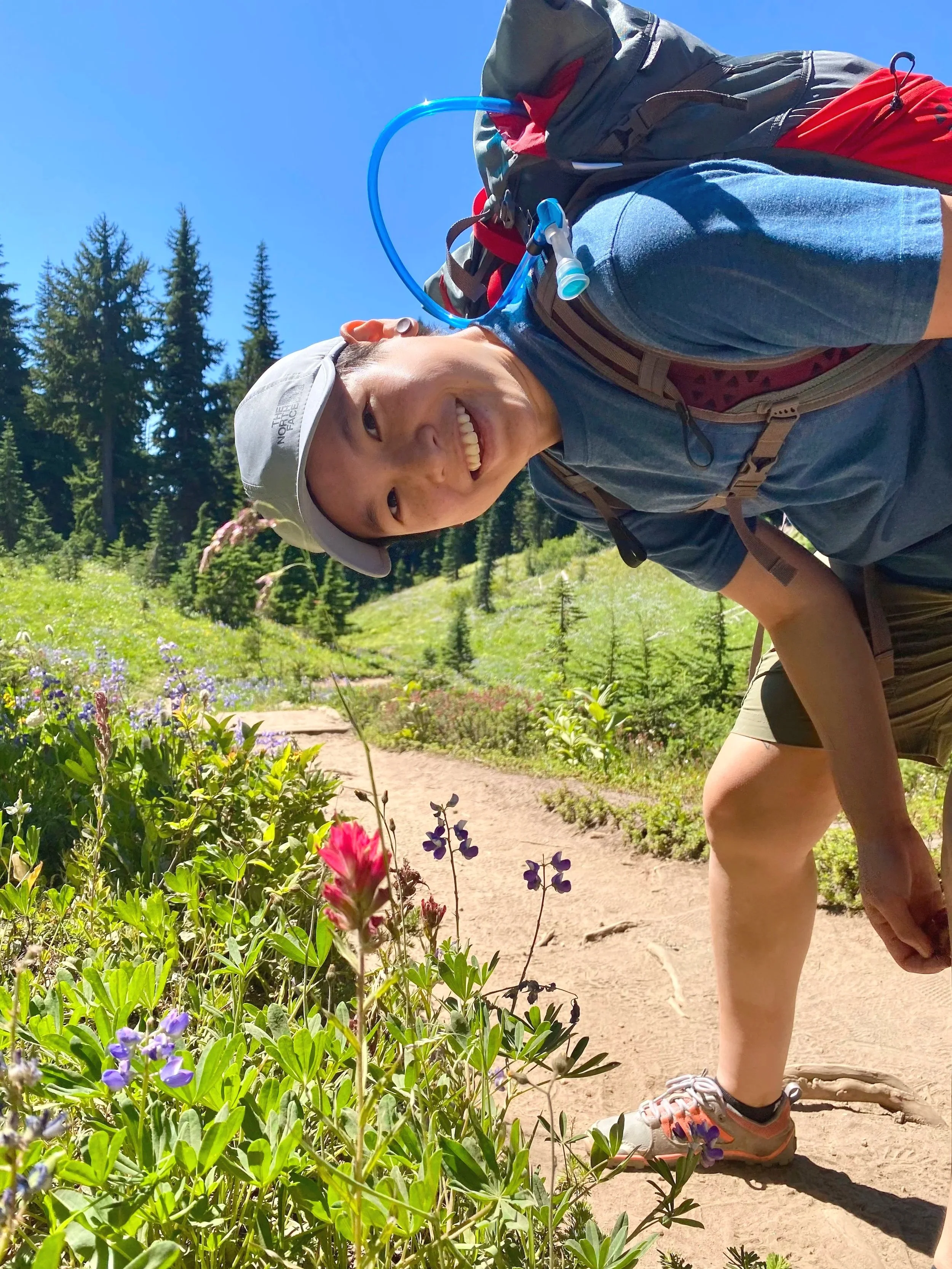
Having recently moved to the area in 2026, I’m very much still learning about all that Colorado has to offer! And what I’ve already discovered is that, once severely hampered by the hilliness and rainy-ness of Seattle, WA (my home of 12 years), the Colorado landscape has renewed my love of bicycling and exploring local trails! Bicycling has now joined my list of favorite activities, which also includes hiking, kickboxing/Muay Thai, modding mechanical keyboards, fussing with uncooperative fountain pens, and amassing a board games collection of unreasonable proportions.
I’m aware that identities are complicated insofar as they are simultaneously socially constructed and also incredibly important, directly shaping our experiences of the world! That being said, I identify as a neurodivergent, ADHD, arthritic queer, trans (of a “they/them”-ish variety), first-generation Taiwanese-American immigrant.
My Story
For most of my life, I was unaware that, since early childhood, I had been living with and masking symptoms of undiagnosed ADHD and juvenile inflammatory arthritis (JIA)/psoriatic arthritis (PA). As a result I spent decades ignoring, circumventing, and coping with recurring symptoms such as restlessness, inattentiveness, hyperfocus, emotional dysregulation, time blindness, and chronic joint pain in my lower extremities. Occasionally, I’d come up with a clever system or two that’d work with my strengths to mitigate some of less stigmatized symptoms. But, far more frequently, when I needed to actually address my most symptomatic behaviors for the sake my health, relationships, studies, or career, I’d find myself oscillating wildly between (1) complete inaction and (2) gritting my teeth, bearing down, and bulldozing through until I was running on fumes. And this was effective enough…for a time.
Shortly before I turned 30, I discovered that, unbeknownst to me, this approach came at a cost much higher than I could have imagined. My body suddenly stopped responding to the over-the-counter non-steroidal anti-inflammatory (NSAID) medications that I had relied on for decades to keep my undiagnosed arthritis in check. For the first time since my pre-teen years, which was when I began to have access to NSAIDs, I found myself once again living with constant incapacitating pain. But this time, there was no NSAIDs off-ramp in sight.
Around the same time, I had little choice but to finally concede that being unceremoniously thrust into a largely self-structured (read: unstructured) PhD dissertation process meant that I could no longer “willpower” and panic my way into extreme last-minute deadline productivity. Even though their effectiveness had been noticeably declining for years, it was still difficult for me to accept that my haphazard duct-tape-and-zip-ties-style self-motivation strategies, which barely worked in the first place, were now, under these new conditions, simply not working at all.
At the time, I viewed the rapid deterioration of my physical health as separate and distinct from the deterioration of my work life. I now recognize that, I am always a person living a life, not simply a part of one. I was not experiencing life through a siloed “work life” and “home life” that somehow remain completely siloed and isolated from one another. Instead all the various facets of my life: physical, mental, personal, social, professional, etc., only exist relative to one another, and therefore constantly shape, affect, inform, and bleed into one another. Therefore, as my physical health and work life deteriorated, seemingly unrelated facets of my life also began to erode. It soon felt like my entire life was disintegrating around me.
But, not unlike a frog in slowly boiling water, I stayed, sat, and stewed for another year, holding onto this hope that long ineffective strategies will suddenly start working again, believing that the only way was through—through pain, self-flagellation, and suffering. For decades, I believed it was totally normal to always feel run down, burnt out, in pain, and wracked with guilt, shame, and self-blame. But, despite the stress, chaos, mental burden, and physical toll of it all, I found that I was, for the most part, able to do what needed to be done. And quite cinematically as well—just in time, right as shit is hitting the fan. But this was not a sustainable way of living, and eventually, something was gonna have to give.
It took me months to finally realize…this time, it was different. Even after several months-long mental “shutdown-reboot” cycles, I was still unable to force myself to leap into action—I was frozen. Overwhelmed, disassociated, and unable to complete tasks even in the face of dire consequences, I found myself in thrall to this voice inside my head chanting a quadruple mantra of incapacitation: “You weren’t,” “You’re not,” “You can’t,” “You’ll never.” The voice grew louder with every piece of evidence I could point to that proved my “deficiencies.” Thus, with only my "lack of self-discipline” to blame, I spiraled into an abyssal shut-down.
It took years of caring, considerate, and intentional interventions from loved ones, mentors, mental health, and medical professionals for me to finally acknowledge that I didn’t have to be alone in this—that I needed, and more importantly, wanted help. It wasn’t as difficult for me to acknowledge that I needed help because frankly…it was hard to argue against it amidst the all-too-conspicuous shambles that was my life.
The Shift
But wanting help? Now, that was a lot harder. And not because of a misplaced insistence on independence, self-sufficiency, and “pulling yourself up by your bootstraps” (though that certainly played a part). The bigger issue was that I only permitted myself to want help in the fleeting moments during which I believed I was deserving of help. To this day, I have to regularly acknowledge and mollify this self-imposed constraint which, if left unchecked, will stop me from seeking more help, different help, or even help in the first place, despite knowing I need it.
At the time of my abyssal shut-down™, the only tasks I could consistently rouse myself for were those related to developing and teaching this recurring university seminar on labor politics, capitalism, and care. Because I was (and am) so deeply invested in this subject matter as potentially paradigm shifting, with lasting relevance beyond the university, even while I let other things fall into disarray, I couldn’t imagine letting my students down. But, I could not anticipate that through teaching a dozen iterations of the course, the questions, conversations, and experiences students shared would lead me to some core understandings of care and deservingness.
By engaging with what would eventually become hundreds of student-collaborators as they committed to the difficult and often uncomfortable work of identifying how various belief systems came into being and produced their working definitions of who/what “deserves care,” I realized that this was slowly and systematically shifting how we perceive deservingness and our intrinsic notions self-worth. Students shared that, by recognizing (and then cyclically forgetting, and then remembering again, etc.) that a set of deeply entrenched, highly active, and yet also unacknowledged and invisible “deservingness rubrics” (a) flattens our complex experiences into an oversimplified binary of good vs. bad, and deserving vs. undeserving, which (b) ultimately does not serve us, while also simultaneously (c) shaping our beliefs, thoughts, sensations, and feelings, they could begin to push back against their rubrics’ harmful constraints in small ways as their capacities to imagine a different way of thinking, feeling, and living expand.
Witnessing the strength of their efforts while insisting that they remain open to receiving help shifted my own pernicious beliefs around receiving help and care. This shift didn’t happen because of an intellectual epiphany that receiving help didn’t make me a bad, lazy, weak, or undeserving person. Not even close. Instead, it took years of intellectual “knowing” and imperceptible shifts in embodied beliefs and feelings before I ever noticed any kind of “transformation.” For me, change happened (and is still happening) imperfectly, through fits and starts, listlessness, enthusiastic off-roading, and above all, persistence and repetition. After a while, I began to notice that the oppressive measuring stick against which I measured my own deservingness was a little less heavy than before, quieter, and overall, a lighter burden to bear.
including that self-deservingness could be extended: from a few minutes at a time, to eventually days, weeks or even months with little faltering.
I am forever grateful for the openness and courage of my students, and the support and guidance of doctors/nurses, mental health counselors, occupational therapists, ADHD coaches, advisers, and loved ones. Their belief in the possibility of change allowed me to begin believing, then occasionally encountering, and now experiencing that living a sustainable and fulfilling life is possible. As a result, I have now been able to spend the better part of a decade unpacking the cadre of harmful beliefs that kept me frozen in place while the water around me rose to boiling. I will forever be grateful to the voices of support who asserted loudly and tirelessly that “change is possible.”
The Now
Change is still scary for me, and even on good days, “embracing” it is probably a bit of a stretch. However, my commitment to leaning towards, instead of away from, its possibilities has helped me realize a life full of curiosity and learning. A life driven, not by the need to succeed by any means necessary, but rather by a commitment to exploring different definitions of “success” that resonate with me. And ultimately, a life dedicated to exploring different ways of thinking, living, and being with ease through all of life’s ups and downs.
Most recently, in focusing on growing my capacity to imagine change, and specifically, change that decreases day-to-day friction and increases day-to-day joy and alignment with my values, I made the decision to transition out of academia and into coaching. In the 12 years I have spent teaching in higher education, I’ve had the opportunity to design and teach dozens of courses on topics such as labor exploitation, capitalism, and caring labor. As a result, I’ve had the privilege of teaching more than a thousand students, and engaging with their struggles and strategies around burnout, perfectionism, ableism, the myth of meritocracy, and “grind culture.” However, due to the constraints of the university and what does and does not “count” as academically “rigorous” research, I found myself constantly yearning for more time and energy to devote to exploring, learning from, and communicating the patterns, ideas, and lessons that emerged from these invaluable discussions.
In 2026, I was teaching as a visiting assistant professor, but with no guarantees of a contract renewal, I found myself once again returning to the churn of the academic job market. Within the first day, I found myself fending off an all-consuming feeling of dread. I was railing against the narrow definitions of academic value to anyone who’d listen: that what the university identifies as valuable nearly universally excludes the aspects of teaching that I’ve personally found to be most fulfilling as well as valuable to and resonant with students—one-on-one advising to explore anything from accommodations to personal interests to career trajectories, conversations driven by curiosity and courage (instead of exams or GPAs), engagement with theory and history grounded in daily struggles and triumphs, and the types of understanding, communication, and connection that are made possible within relationships built on compassion, trust and care—the very aspects of teaching that most resemble the work of coaching. And so, after a not inconsequential period of disbelief/denial of just how suffocated, drained, and burned out I felt in academia, it occurred to me to practice what I preach: to consider the possibility of change—towards contentment, fulfillment, and joy.
This journey ultimately led me here, to Jey Saung Coaching. Coaching is where I have found I can best provide everything I have to offer, ranging from my own personal experiences, nearly 20 years of martial arts coaching, 14 years of teaching with 12 years in higher education, and a unique historical and systems-level analysis that explores everyday struggles through a holistic anti-oppression lens. I very much look forward to sharing all of this and more to discover your own sustainable and fulfilling
Believe in the possibility of change.
Send me a message and we can chat about how you could begin to deepen your understandings, feel lighter, and breathe easier today.